
FinTech
Fintech Website Best Practices: How Modern Fintech Companies Build Trust That Converts
Discover the website best practices leading fintech companies use to build trust, communicate security, and turn more visitors into customers.
OmniLayer · Aug 8, 2026 · 7 min read
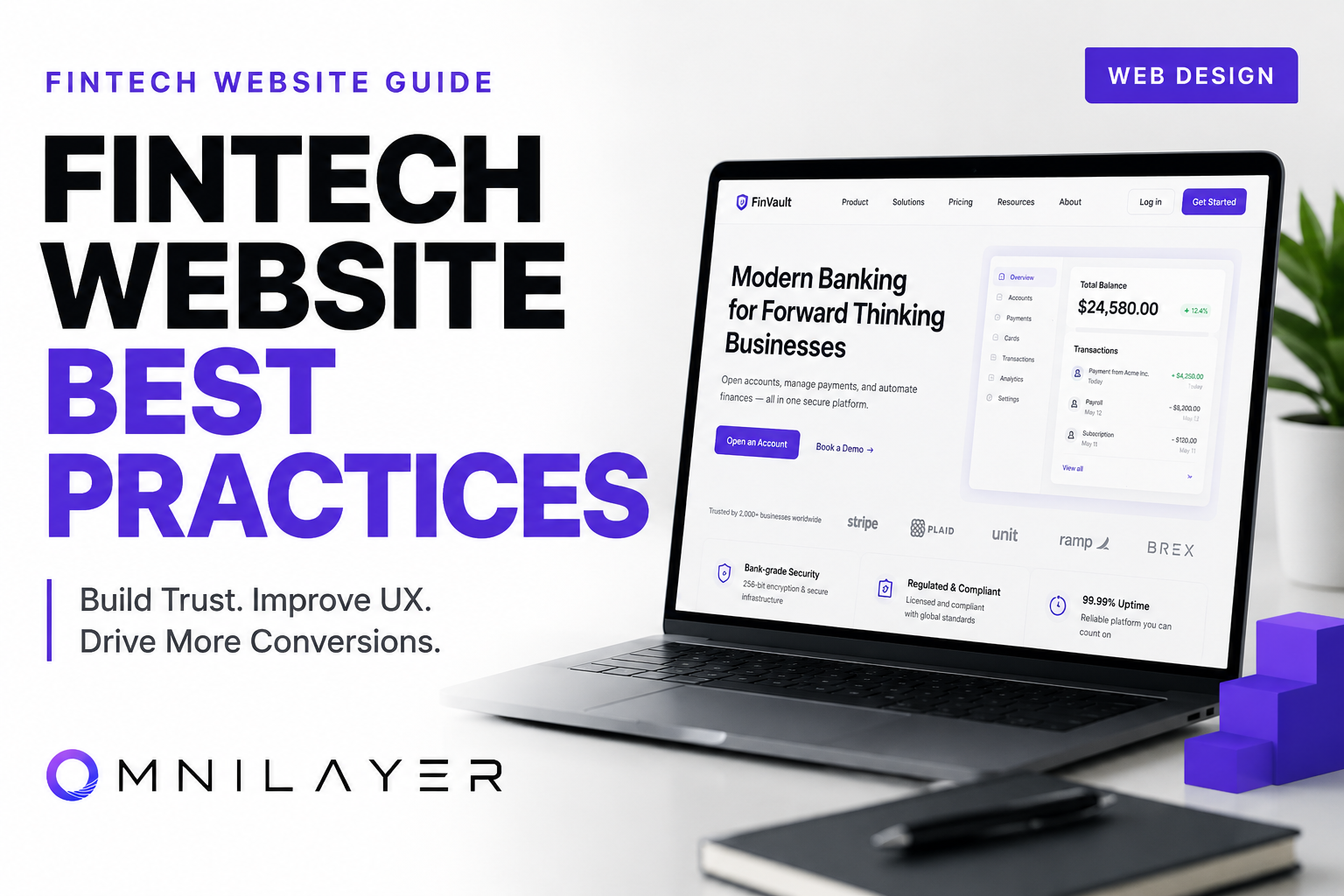
Financial technology has transformed how people bank, invest, borrow, insure, and make payments.
But while fintech products continue to evolve rapidly, one thing hasn't changed:
People don't trust financial products easily.
Unlike buying a t-shirt or ordering food, fintech asks users to trust you with their money, identity, and financial future.
That means your website isn't just a marketing asset.
It's your biggest trust-building tool.
A slow, outdated, or confusing website can instantly damage credibility, no matter how innovative your product is.
Here are the website best practices every fintech company should follow.
Build Trust Within the First Five Seconds
Visitors decide almost instantly whether your company feels legitimate.
Your homepage should immediately answer three questions:
- What do you do?
- Who is it for?
- Why should someone trust you?
Avoid vague headlines like:
Reinventing Financial Innovation
Instead, be specific.
For example:
Business Banking for Indian Startups.
Open an account in minutes. Manage payments, invoices, and payroll from one dashboard.
Clarity always beats cleverness.
12 Fintech Website Best Practices
1. Make Security Impossible to Miss
Financial products require trust before conversion.
Highlight security throughout your website—not just on a compliance page.
Show things like:
- SSL encryption
- Regulatory licenses
- Data privacy commitments
- Compliance certifications
- Secure payment providers
- Bank-grade security
People should never wonder:
"Is my money safe here?"
Answer that before they ask.
2. Keep Navigation Extremely Simple
Fintech products are already complex.
Your website shouldn't be.
A clean navigation might include:
- Product
- Solutions
- Pricing
- Security
- Resources
- About
- Contact
Reduce friction wherever possible.
If visitors need to think about where to click, you've already lost momentum.
3. Explain Complex Products Like You're Talking to a Friend
Most fintech companies understand finance.
Most customers don't.
Replace technical language with simple explanations.
Instead of:
AI-powered cross-border treasury optimization.
Say:
Move money internationally faster while reducing transfer costs.
Simple language converts better because everyone understands it.
4. Use Real Numbers Instead of Generic Claims
Avoid empty statements like:
- Best platform
- Trusted by many
- Fast service
- Industry-leading
Instead, show measurable proof.
Examples:
- $3B+ transactions processed
- 500,000 customers
- 99.98% uptime
- Average onboarding time: 4 minutes
- 4.9★ customer rating
Specificity builds credibility.
5. Show Real Customer Success Stories
Trust grows when prospects see people like themselves succeeding.
Feature:
- Customer testimonials
- Video interviews
- Case studies
- Business outcomes
- Before-and-after metrics
Focus less on praise and more on measurable impact.
6. Design for Mobile First
Many users discover fintech products on mobile.
Your website should feel native on every screen.
Prioritize:
- Fast loading
- Large tap targets
- Readable typography
- Minimal forms
- Smooth scrolling
- Responsive layouts
Mobile usability directly impacts conversions.
7. Optimize Website Speed
Every second matters.
Slow websites increase bounce rates and reduce sign-ups.
Best practices include:
- Optimized images
- Modern frameworks
- Lazy loading
- CDN delivery
- Minimal JavaScript
- Efficient hosting
Fast websites feel more trustworthy.
8. Make Your Call-to-Action Crystal Clear
Every page should guide visitors toward one primary action.
Examples:
- Open an Account
- Book a Demo
- Start Free Trial
- Talk to Sales
- Get Started
Avoid overwhelming users with too many competing buttons.
One page.
One goal.
9. Educate Before You Sell
Finance is complicated.
People research before making decisions.
Publish educational content such as:
- Industry guides
- Product comparisons
- Security explainers
- Financial calculators
- Market insights
- Compliance resources
Helpful content builds authority while improving SEO.
10. Don't Hide Your Pricing
Whenever possible, be transparent.
Visitors appreciate knowing:
- Starting price
- Plans
- Transaction fees
- Free trials
- Enterprise options
Hidden pricing creates unnecessary friction.
If custom pricing is required, explain why.
11. Keep Branding Consistent Everywhere
Trust comes from consistency.
Your website should maintain the same:
- Colors
- Typography
- Messaging
- Icons
- Illustration style
- Voice
Every page should feel like part of one polished product—not several different websites stitched together.
12. Focus on Clarity Before Creativity
Beautiful visuals can capture attention.
Clear messaging keeps it.
Every section of your website should help visitors understand:
- What you offer
- Why it matters
- Why they should trust you
- What they should do next
A visually stunning website with confusing messaging will still struggle to convert.
Common Mistakes We See on Fintech Websites
Many fintech companies lose conversions because they:
- Use confusing financial jargon
- Prioritize design over clarity
- Hide trust signals
- Overcomplicate navigation
- Ignore page speed
- Bury CTAs
- Use generic stock imagery
- Fail to explain product benefits clearly
Most of these issues are surprisingly easy to fix.
Final Thoughts
A fintech website isn't just about looking modern.
Its primary job is to reduce uncertainty.
Every headline, testimonial, security badge, product explanation, and design decision should answer one silent question in the visitor's mind:
"Can I trust this company with my money?"
When your website communicates trust, clarity, and credibility from the very first interaction, conversions become a natural outcome.
At OmniLayer, we build high-performance websites for fintech, SaaS, and B2B technology companies—combining strategic messaging, modern design, and conversion-focused user experience to help ambitious businesses turn more visitors into customers.
Stay in the loop
Get our best content in your inbox
No spam, just insights on conversion, design, and SaaS growth.