Startup Strategy
Landing Page vs Website: Which Does Your Startup Actually Need?
Choosing between a landing page and a full website depends on your startup's stage, goals, and growth strategy. Here's how to make the right decision without wasting time or money.
OmniLayer · Jul 7, 2026 · 5 min read
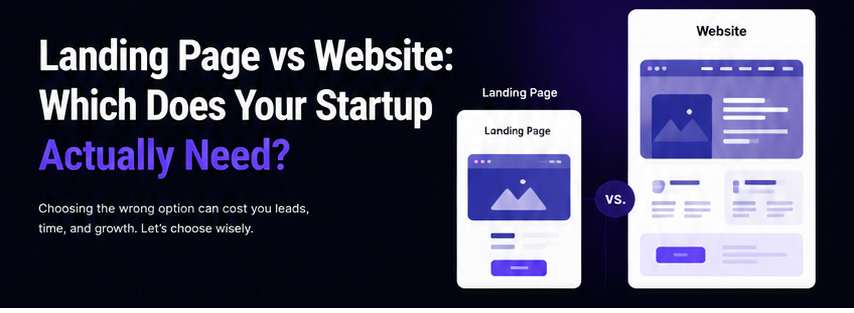
Choosing the wrong option could cost your startup leads, valuable time, and thousands of dollars.
One of the most common questions founders ask before launching is:
"Should we build a landing page first or invest in a complete website?"
It's also one of the most misunderstood decisions.
Some founders spend months building a 15-page website when a single landing page could have generated their first customers.
Others launch with only a landing page when they've already reached a stage where credibility, SEO, and trust demand a complete website.
Neither option is inherently better.
The right choice depends on your current stage, your goals, and your growth strategy.
First, What's the Difference?
Although people often use the terms interchangeably, a landing page and a website serve completely different purposes.
Landing Page
A landing page is built around one objective.
Common goals include:
- Generate leads
- Book demos
- Sell one product
- Launch a startup
- Validate an idea
- Collect waitlist signups
Everything on the page supports a single conversion goal.
There are minimal distractions.
One message.
One audience.
One CTA.
Website
A website is your company's digital headquarters.
It serves multiple purposes at the same time, including:
- Building credibility
- Explaining your company
- Showcasing products or services
- Publishing blogs
- Improving SEO
- Supporting customers
- Generating leads
- Recruiting talent
Unlike a landing page, visitors can explore multiple pages depending on what they're looking for.
Think of It This Way
A landing page is like a salesperson focused on closing one deal.
A website is like an entire sales team.
Every page has a different responsibility.
Decision Tree: Which One Should You Build?
Answer these questions honestly.
Build a Landing Page if you are:
- Launching your first product
- Running paid ads
- Collecting early users
- Validating an idea
- Promoting one offer
Build a Website if you are:
- Building long-term brand authority
- Investing in SEO
- Selling multiple products or services
- Targeting enterprise customers
- Scaling your company
Need Both?
For most startups, we recommend this sequence:
- Build a high-converting landing page.
- Generate leads.
- Validate demand.
- Expand it into a complete website.
It's often the fastest, most cost-effective, and lowest-risk approach for early-stage companies.
Typical Pricing & Timeline
Every agency prices projects differently, but here's a realistic benchmark.
Landing Page
Typical investment: $1,000–$3,000
Usually includes:
- Research
- Messaging
- Copywriting
- UI Design
- Development
- Responsive optimization
- Basic SEO
- Conversion optimization
Typical timeline: 1–2 weeks
Ideal for:
- MVP launches
- Beta signups
- Product Hunt launches
- Investor demos
- Early traction
Website
Typical investment: $3,000–$10,000+
Usually includes:
- Homepage
- Services pages
- About page
- Pricing
- Blog
- Contact
- CMS integration
- SEO structure
- Performance optimization
Typical timeline: 3–6 weeks
Ideal for:
- Funded startups
- Growing SaaS companies
- Businesses investing in SEO
- Established companies
Real Use Cases
Build a Landing Page If...
You're:
- Launching a startup
- Testing a new idea
- Running paid advertising
- Promoting one offer
- Collecting leads
- Building a waitlist
- Launching a new feature
A landing page keeps visitors focused on taking one action.
Build a Website If...
You're:
- Building long-term brand authority
- Selling multiple services
- Publishing content regularly
- Investing in SEO
- Hiring employees
- Targeting enterprise customers
- Serving different customer segments
A complete website gives visitors confidence to explore your business.
The Biggest Mistakes Founders Make
After reviewing dozens of SaaS websites, the same mistakes appear repeatedly.
Mistake #1: Building a Full Website Too Early
You don't need ten pages before validating your offer.
More pages don't automatically generate more customers.
Start simple.
Grow intentionally.
Mistake #2: Using Your Homepage Like a Landing Page
Your homepage shouldn't try to sell everything.
Visitors become overwhelmed.
Every page needs a clear purpose.
Mistake #3: Too Many Calls-to-Action
Examples include:
- Book Demo
- Start Free Trial
- Read Blog
- Watch Video
- Contact Sales
- Download Guide
When everything feels important…
Nothing feels important.
One page.
One goal.
One CTA.
Mistake #4: Prioritizing Design Over Messaging
Many founders obsess over animations.
Very few obsess over clarity.
Visitors don't buy because your gradients look beautiful.
They buy because they understand your value.
Great messaging beats great visuals every time.
Mistake #5: Ignoring Mobile Users
More than half of website visitors come from mobile devices.
Yet many startup websites are still designed desktop-first.
If your mobile experience is frustrating, conversions will suffer.
Mistake #6: Waiting for Perfection
This is one of the biggest mistakes founders make.
Months are spent polishing a website while gaining:
- No users
- No feedback
- No customers
Launch.
Learn.
Improve.
Your website should evolve alongside your business.
What High-Converting Pages Have in Common
Whether you're building one page or twenty, the fundamentals remain the same.
Every successful page answers four questions within seconds.
1. What Do You Do?
Be specific.
Avoid buzzwords.
2. Who Is It For?
Not everyone.
The right people.
3. Why Are You Different?
Give visitors a compelling reason to choose you.
4. What Should I Do Next?
Present one clear CTA.
No confusion.
So... Which One Should You Choose?
Build a Landing Page if:
- You're early-stage.
- You have one offer.
- You need leads quickly.
- You're validating an idea.
- You're running paid ads.
Build a Website if:
- You're growing.
- You need credibility.
- You're investing in SEO.
- You offer multiple services.
- You're building a long-term brand.
The Best Strategy
For most startups, the smartest approach isn't choosing one over the other.
It's building them in sequence.
Start with a landing page.
Validate your messaging.
Generate customers.
Learn what resonates.
Then expand into a complete website based on real user feedback.
It's faster.
Cheaper.
And significantly less risky.
Final Thoughts
A website isn't an expense.
It's one of your company's most valuable business assets.
Your product may be exceptional.
Your team may be world-class.
But if your website fails to communicate that value, visitors won't stay long enough to discover it.
Instead of asking:
"Should I build a landing page or a website?"
Ask:
"What does my business need right now?"
The answer is usually much clearer.
At OmniLayer, we help SaaS, AI, and B2B technology companies build websites that do more than look premium.
We create digital experiences that build trust, reduce friction, and turn more visitors into customers.
Whether you're launching your first product with a high-converting landing page or scaling with a complete website, the goal remains the same:
Build something that wins.
Stay in the loop
Get our best content in your inbox
No spam, just insights on conversion, design, and SaaS growth.